by Jim Robertson, President of C.A.S.H.
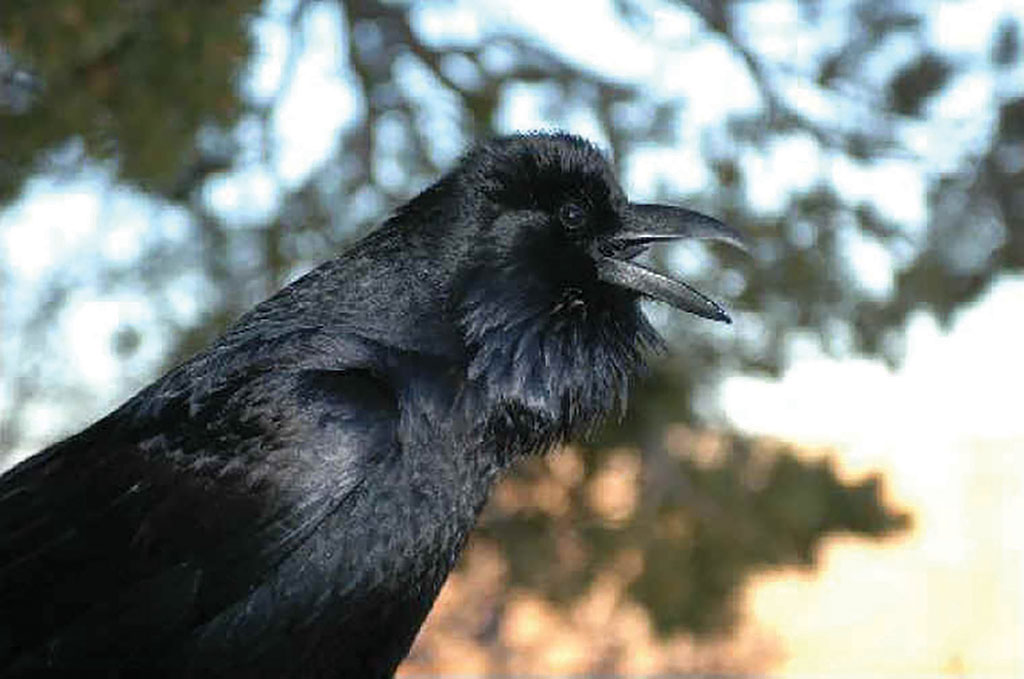
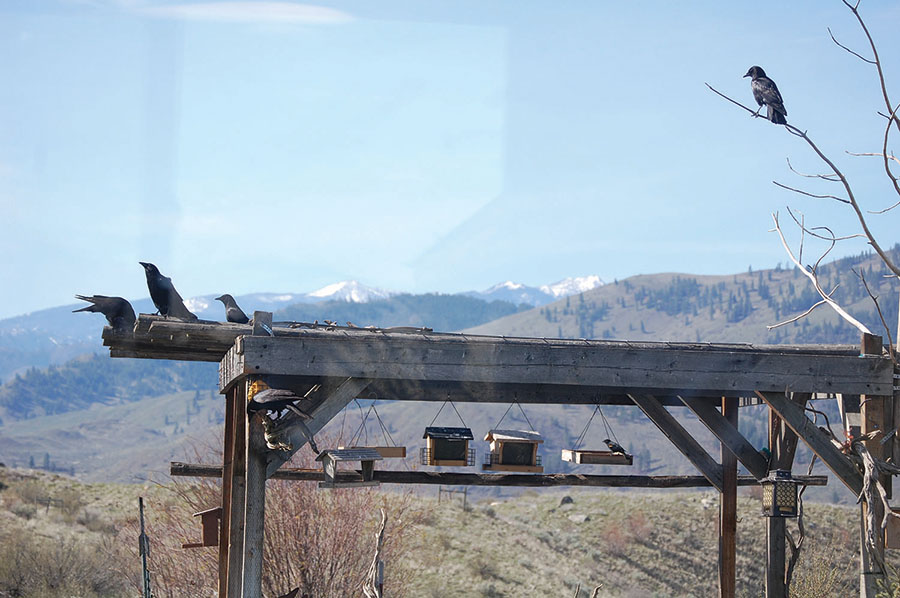
While pondering what to write about for my main article in this Spring/Summer issue of the C.A.S.H. Courier you hold in your hands, three crows landed in the tree just outside my window. My thoughts sprang immediately to the question of who the hell would want to “hunt” (i.e., shoot, murder, blast out of existence) these highly intelligent, social animals? Unfortunately, I already knew the answer: sport hunters…
Although crows are seemingly protected under the Migratory Bird Treaty Act, states that claim crop damage can get a federal “depredation order” allowing up to four months of recreational slaying per year. Dozens of states have not only imposed hunting seasons, but also hold major contest hunts on the species, despite the fact that crows (along with ravens) can outthink every other bird and most mammals, including dogs, apes and human children up to an age group that depends on the child’s proficiency with (and/or addiction to) their smart phone.
Still, no amount of intellect seems to spare adaptable species like crows from inclusion in the ranks of sporthunting targets. Recent headlines in crow-hunting states, such as, “Wyoming Crow Hunters Can Blast All They Want, But Nobody Eats the Birds” reveal just how eager some hunters are to train their sights on anything newly added to the Ok-to-kill list. In several states, there’s not even a “bag limit” on the brainy-yetembattled corvids.
Near the end of her life in 1964, environmental author Rachel Carson famously wrote, “We cannot have peace among men whose hearts find delight in killing any living creature.” If she had written those words today, she would have perhaps substituted “enjoyment,” “pleasure” or “amusement” for “delight” if she wanted to appeal to mainstream twenty-first century sensibilities.
As Russian politician Oleg Mikheyev told the daily newspaper, Izvestia, “People who feel pleasure when they kill animals cannot be called normal. [Testing animal-killers] can help us in early detection of latent madmen and murderers.”
For the majority of people in today’s world, “delight” may seem a bit of an antiquated term for the perverse pleasure hunters get from ‘harvesting’ animals. “Harvest” is hunters’ and their apologists’ current favorite word for it because of its innocuous, wholesome connotations meant to misinform an unwary public.
A more precise (albeit clearly less noble or righteous) synonym for what hunters aim to do to animals would be “destroy,” “eradicate” or “annihilate.” Meanwhile, words like “liquidate,” “vaporize” or “snuff out,” although a tad too honest and blatantly obvious for their purposes, more clearly convey their true, underlying thoughts about and lack of respect for their animal victims (whom they de-aminate and depersonalize in much the same way that racists or sexists did their fellow humans in earlier, bygone days). And why shouldn’t it be okay for us to call out mindsets or behaviors regarding non-humans in the same way that forward-thinking folks did for humans in other unenlightened eras?
Of course, not every hunter in the modern world tries to mask their insanity with soft-selling synonyms. A hunting magazine known as the Carolina Sportsman recently published an article unabashedly entitled “How to kill that early season gobbler.” Apparently, the article’s author figured if he doesn’t acknowledge the animal’s species, he won’t even have to allow it the dignity you’d afford a turkey.
The article features a photo of a beaming 4-year-old towhead kid sitting beside a beautiful, yet clearly deceased Tom turkey and spreading out its tail feathers with pride (pride for his daddy, that is, since the kid wasn’t quite big enough to shoulder a shotgun).
A twenty-first century revival of hunting makes no sense, but some factions of the media gobble it up, busily trying to drag us back to the Stone Age by promoting the sport. But I have to believe we’re still evolving overall as a species. Therefore, it shouldn’t be considered out of line to suggest we stop using the term “human rights,” when talking about things that should be basic rights for all species. Indeed, the human race doesn’t need anything else singling it out to stroke its over-inflated, collective ego.
Differentiating between human and non-human rights just encourages those who sneer or scoff at the idea of animal rights. Call it fairness, justice or common decency; or call them natural rights or individual rights. Better yet why not just use the term animal rights and include human beings in with our fellow animal individuals, all deserving of kindness, consideration and respect. This notion of human superiority is for the birds.
Those of us who grew up watching “All in the Family” knew that the patriarch, Archie Bunker, wasn’t always right (to say the least). Yet often the first reaction from people when they learn that C.A.S.H. is an anti-hunting group is an indignant, ‘But my father was a hunter!’ Well, so? Look at all the other outdated activities and attitudes we’ve turned our backs on—slavery, racism, sexism all went out of fashion without anyone arguing, ‘But my father was a racist—or a sexist—or a slave owner.’
What’s so sacred about hunting that makes it harder to kiss goodbye than any of our parents’ other wrong-headed behaviors? Maybe it’s that nearly everyone you meet is as blind to their anthropocentric prejudice of speciesism as Archie Bunker was to his isms. But many people seem unwilling or unable to share their compassion with the non-human animals of this world.
On the other hand, I don’t feel sorry for today’s youth whose parents lived during more enlightened times; they really have to work at finding things to rebel about. Lately we’ve been seeing a disturbing new trend: some of today’s young people, who were raised in caring homes by non-hunting parents, are embracing hunting out of some kind of misguided sense of rebellion for rebellion’s sake.
Hey kids, if you feel an overwhelming urge to lash out against your parents, please don’t take it out on the animals. Turning to hunting does not make you hip, it makes you an animal abuser, like the budding future serial killer who throws rocks at birds or smashes frogs on the pavement. (Note to prospective parents: Don’t fool yourself into thinking you can bring a new human into this world and expect to shape their way of thinking—it doesn’t often work out the way you might hope).
One of hunters’ favorite names to call those of us who are against hunting is “antis.” Yet hunters themselves are antis in their own right—they are anti-wildlife, anti-nature and anti-competition (from natural predators), i.e., they’re anti-cougar, anti-coyote and unquestionably anti-wolf. At the same time, they’re pro-killing and when it comes right down to it, pro-animal cruelty.
But after seeing the inexplicable rise in the popularity of hunting T.V. shows, not to mention articles glorifying hunting in every paper or periodical across the country, I’m ready to admit I’m an all-out anti. Not only am I anti-hunting, anti-trapping, anti-whaling and anti-sealing, in fact I’m anti any form of bullying that goes on against the innocents—including humans. I am not an apologist for the wanton inhumanity of hunting in the name of sport, pseudo-subsistence or conservation-by-killing. And I’m anti any so-called society that allows or encourages such atrocities.
But although I might seem to be a misanthropist, I’m not really across the board anti-human per se. Actually, I’m anti-hate, as well as anti-greed and anti-ignorance; I’m anti-objectification, anti-manipulation, anti-exploitation; I’m anti-thoughtlessness, anti-selfishness, and anti those individuals who regularly exhibit any of these behaviors or embrace these traits.
Ever since the first hominid shunned our primate predecessor’s plant-eating lifestyle and sank its teeth into the flesh of another animal, our hairy fore-bearers have been scratching their heads, and armpits, trying to devise deadlier weapons than their neighbors. The simple, sharpened stick, later recognizable as the spear, reigned for over a hundred centuries before the atlatl propelled the human predator to a higher level of planetary destruction. With that new technology, localized over-hunting—then early mass extinctions—followed the spread of Homo sapiens to every corner of the earth. Later, of course, gunpowder unleashed a firestorm the likes of which the world had never known.
You may ask, so why bring this up? Why not let people have their illusions about their peaceful origins and the notion that any humans were in harmony with nature in their animal exploitation? Because belief in that fantasy only fuels the case for hunting and delays the day we finally move beyond it as a species.
As Harvard biological anthropologist Richard Wrangham and author Dale Peterson, wrote in their 1996 book, Demonic Males: Apes and the Roots of Human Violence, in a chapter aptly titled “Paradise Imagined,” “To find a better world we must look not to a romanticized and dishonest dream forever receding into the primitive past, but to a future that rests on proper understanding of ourselves.”
But I don’t hold all people of today’s world equally to blame—I certainly don’t blame anyone who truly qualifies as an animal advocate. You can’t help being born human any more than a wolf, a sea lion, salmon or slug has any say over who or what they were born. But there are those who seem to go out of their way to fuel my misanthropy. You see, some humans don’t just kill other animals to fill their bellies; they destroy them in droves out of spite, to eliminate the competition or, in the case of crow hunting, just for fun.
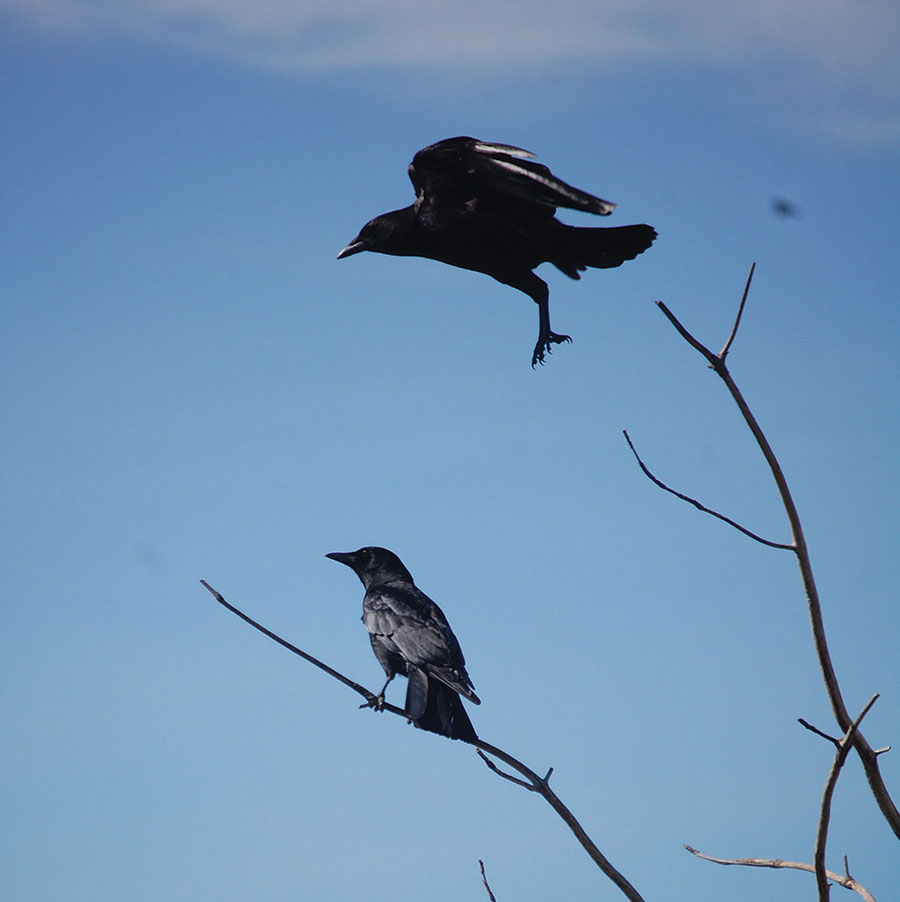
Which brings us back to crow hunters. Upon awakening from a fitful sleep after a cold, windy night, it occurred to me that birds must have to keep an unconscious death-grip on the branch they’re perched on to hold their place until morning. It must be second nature to them; part of what makes them who they are.
Next the thought came to me that a bird’s nighttime death-grip on a perch is analogous to the death-grip “sportsman’s” groups, “game” departments and the “livestock” industry have on our wildlife. Like a trembling bird, fearful for its future, animal exploiters must be afraid that if they loosen their grip, they’ll be blown away.
Well, they’re right!
It’s high time we be like the wind that finally breaks loose their death-grip on wildlife once and for all.
Jim Robertson is the President of C.A.S.H. He’s the author of Exposing the Big Game: Living Targets of a Dying Sport. You can order Jim’s book on Amazon.