Proposed kill quota over one-third of the population
Date
July 18, 2026
Contacts
Lizzy Pennock, WildEarth Guardians, lpennock@wildearthguardians.org
Clint Nagel, Gallatin Wildlife Association, clint_nagel@yahoo.com
Dr. Anja Heister, Footloose Montana, anja@footloosemontana.org
Nadia Steinzor, Project Coyote, nsteinzor@projectcoyote.org
Josh Schott, Team Wolf, joshdschott@gmail.com
HELENA, Mont. — Yesterday, Montana Fish, Wildlife & Parks (FWP) proposed regulations for the 2026-27 wolf hunting and trapping season and published the 2025 Annual Wolf Report. FWP admitted that the state’s population model has been overestimating the wolf population for years, which the state now estimates to be near 725—almost 400 less than what FWP told the public last year.
“FWP finally admitted what we’ve been saying for years: the state’s wolf counts were wrong and they’ve been misleading the public,” said Lizzy Pennock, carnivore coexistence attorney at WildEarth Guardians. “Yet FWP is still proposing to kill a third of Montana’s wolves in one season. The agency remains more interested in managing wolves for the bare minimum instead of treating this beloved species with respect.”
Although FWP has proposed a lower quota than last year—250 wolves—it still represents at least 35% of the population. Montana will also allow numerous killing methods that are not legal for other managed species, including baited traps and snares, artificial light, night vision, and thermal and infrared imaging—all of which violate fair chase principles. Bounties of up to $1,500 per dead wolf will be allowed by Montana law, paid by the Foundation for Wildlife Management.
“Every year, FWP has a chance to come to its senses and base wolf management policies more on science and ecological considerations, and less on the desire of hunters and trappers to kill as many wolves as possible,” said Nadia Steinzor, carnivore conservation director with Project Coyote. “The agency’s quota is lower but its proposal is just more of the same–and not what most Montanans want.”
The state’s wolf population model, iPOM, has garnered significant controversy since FWP started using it in 2021. Peer-reviewed literature published by independent experts determined that iPOM is an inappropriate method for counting wolves and likely overestimates the population. Since 2021, the iPOM estimate has shown little to no change despite heavy killing each year. But the 2025 Wolf Report provides two estimates–one estimate of 1,094 wolves using the original iPOM—little or no change from last year—and one estimate of just 725 wolves using the state’s newly updated version of iPOM—a significant decrease.
“Science, common sense, and a sense of morality are still missing in wolf-management decisions made by Montana Fish, Wildlife, and Parks,” said Clint Nagel, president of the Gallatin Wildlife Association. “This is especially true with the knowledge and revision of wolf estimates in Montana. The state really needs to listen to the science and the good citizens of Montana.”
FWP also proposed three-wolf quotas for each of the two wolf management units (WMU) 313 and 316 north of Yellowstone National Park. Multiple wolves have been poached in these units in the past few seasons. One of the wolves poached last season was a female from the famous Yellowstone Junction Butte Pack. Someone killed her on Christmas Day, despite the unit where she was killed being closed since mid-November. In the 2024/25 season, people killed five wolves in WMU 313 despite a three-wolf quota, meaning two were poached. Evidence showed that all five wolves were shot in one day.
“When a beloved Yellowstone wolf can be killed on Christmas Day in a unit that was supposedly closed weeks earlier, it’s clear these regulations aren’t protecting wildlife, but providing cover to kill as many wolves as possible,” said Josh Schott, Rocky Mountain Coordinator for Team Wolf. “A quota means nothing without enforcement, and allowing trophy hunting and trapping after a unit closes is an invitation for more senseless killing. Montana deserves real accountability, not rules written to serve a few fringe special interest groups at the expense of our public lands, our unique wildlife, and our Montana values.”
Contrary to what FWP’s proposals demonstrate, the public largely supports wolves. Recent research out of the University of Montana showed that 74% of Montanans are tolerant or very tolerant of wolves on the landscape, a number that has increased significantly since 2012. On the other hand, tolerance for wolf hunting and trapping has decreased significantly since 2012, with only 36% of Montanans reporting that they tolerate trapping. According to the study, “a strong majority of Montana residents have positive attitudes toward wolves and tolerate them on the landscape.” However, the study also noted that the “minority of Montanans who have exceedingly negative attitudes towards wolves . . . represent a significant and influential segment of the population.”
“Montana officials have abandoned all respect for wildlife,” says Anja Heister, executive director of Footloose Montana. “What’s happening to large carnivores such as wolves, bears and mountain lions, along with ‘furbearing’ animals has nothing to do with science and compassion. Instead, it is slaughter dictated by the trapping and trophy hunting industry, including outfitters, for recreation and profit.”
The Montana Fish and Wildlife Commission will pass hunting and trapping regulations at the Commission meeting on August 19th, 2026. The seven-member Fish & Wildlife Commission includes livestock ranchers, outfitters, and hunters. None of the current Commission members has a background in wildlife science or management.
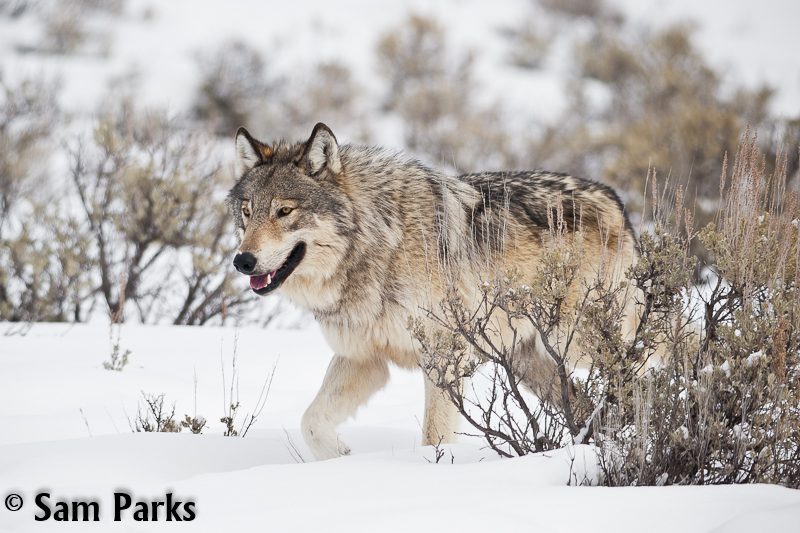
Gray wolf in winter in Yellowstone National Park. Photo by Sam Parks.