
Burrow hunting – game with game
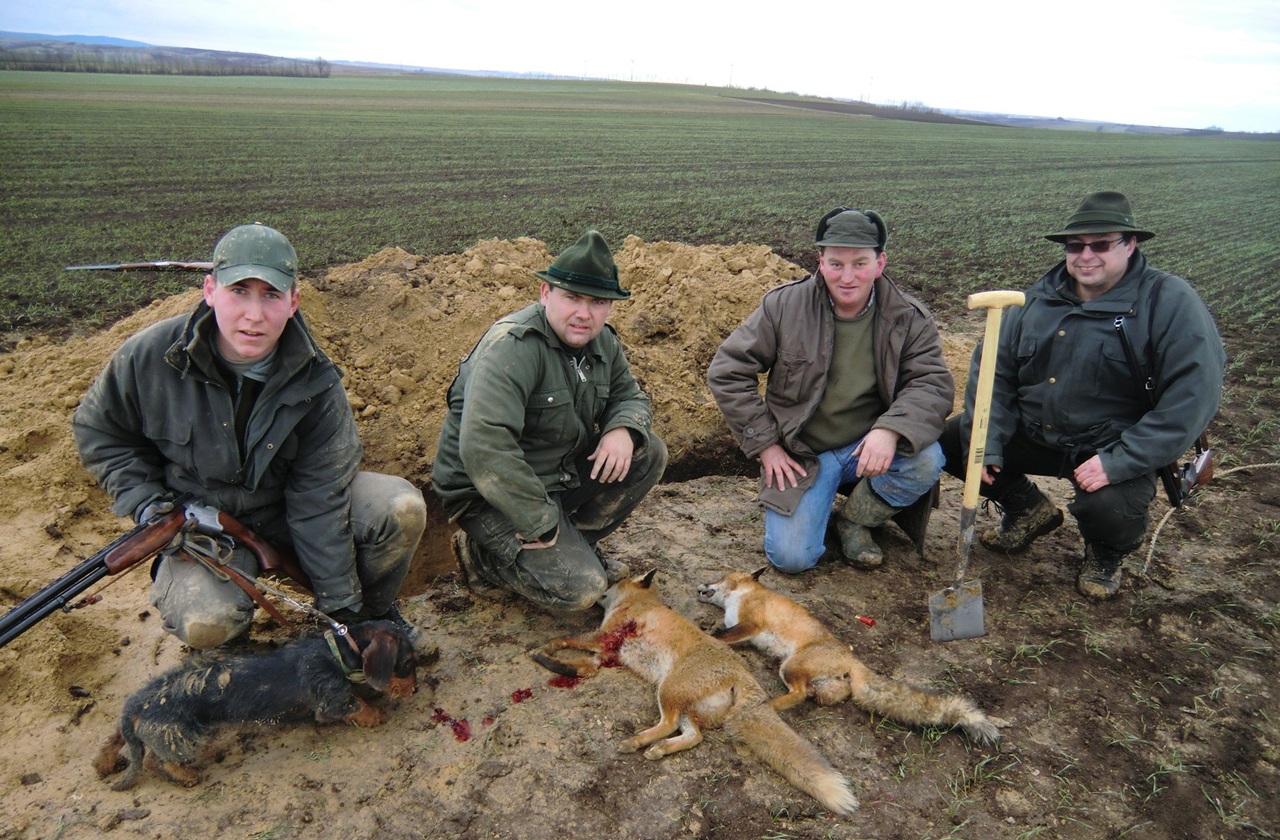
Burrow hunting means: Hunting dogs are sent into fox or badger burrows to harass predators underground so that they can be shot outside. What happens in the process is beyond public control: underground confrontations, bites, blockages in the narrow pipe system, serious injuries – for the wild animal and for the dog. A legal opinion by the Animal in Law Foundation concludes: The practice of burrow hunting can meet the criteria of animal cruelty several times under animal welfare law.
Several Swiss cantons have drawn conclusions from this. Thurgau was the first canton to ban burrow hunting in 2017 by Grand Council resolution. Zurich followed suit on 1 January 2023 with a new cantonal hunting law. Basel-Landschaft has banned in principle, with exceptions. In 2024, Bern decided on a far-reaching ban with narrowly worded exemptions. The canton of Vaud banned burrow hunting as of 15 December 2021. At the same time, motion 23.3303 “Ban on cruel burrow hunting” is underway at the federal level. The trend is clear – and it can also be applied to cantons that do not yet have a binding regulation.
What to expect here
- What is burrow hunting and how it works: Method, process, animals involved and the decision of the cantonal government of Solothurn as a primary source.
- The main problem: invisibility and lack of control: Why burrow hunting takes place exactly where public control is least possible.
- Animal suffering is systemic, not an isolated case: What Tier’s legal opinion in law specifically states.
- Schliefanlagen: The training industry of burrow hunting: What happens to foxes in artificial training facilities – and what the German Animal Welfare Association says about it.
- Kantonale Rechtslage aktuell: Stand 2026 – wer verboten hat, wer noch nicht, und wo Ausnahmen das Verbot aushöhlen.
- Motion 23.3303: Baujagd als Bundespolitik-Thema: Wo die Bundesebene steht und warum das wichtig ist.
- JagdSchweiz-Argumente und ihre Widerlegung: Die Lobby-Positionen im Faktencheck.
- Forderungen der IG Wild beim Wild: Was ein echtes, lückenloses Verbot bedeuten würde.
- Was du tun kannst: Handlungsoptionen für Privatpersonen, Organisationen und politische Akteure.
- Quicklinks: Alle Belege, Gerichtsquellen, Medienberichte und Dossiersbeiträge.
Was Baujagd ist und wie sie abläuft
Baujagd ist eine Jagdform, bei der ein sogenannter Bodenhund in den Bau eines Fuchses oder Dachses geschickt wird. Der Hund dringt in den Bau ein – ein verzweigtes unterirdisches Röhrensystem –, bedrängt das Wildtier und treibt es durch die Gänge nach aussen. Draussen postieren sich Hobby-Jägerinnen und Hobby-Jäger um den Bau und versuchen, den Fuchs oder Dachs beim Verlassen zu erlegen. Das beschreibt ein Regierungsratsbeschluss des Kantons Solothurn direkt und unverblümt.
Dachs und Fuchs sind die Hauptzieltiere der Baujagd. Der Dachs ist in der Schweiz nicht jagdbar – Baujagd auf Dachse ist bundesrechtlich grundsätzlich nicht zulässig. Beim Fuchs ist die Rechtslage kantonal unterschiedlich. Entscheidend: Baujagd ist nie eine Massnahmejagd mit nachgewiesenem Schaden als Voraussetzung. Sie wird als reguläre Jagdmethode eingesetzt – also als Freizeitjagd im Verborgenen.
Mehr dazu: Jagd in der Schweiz: Faktencheck, Jagdarten, Kritik und Fallenjagd in der Schweiz
Das Hauptproblem: Unsichtbarkeit und fehlende Kontrolle
Baujagd passiert unter der Erde. Was im Bau passiert, entzieht sich jeder öffentlichen Kontrolle. Kontakt zwischen Hund und Wildtier im engen Röhrensystem, Bisse, Blockaden, Erschöpfung und Panikzustände sind nicht nur möglich – sie sind strukturell wahrscheinlich, weil zwei Tiere unterschiedlicher Arten in einem minimalen Raum ohne Ausweichmöglichkeit aufeinandertreffen.
Even if someone claims that burrow hunting is carried out “cleanly”, the method produces structurally uncontrollable situations. Dogs get stuck in the burrow and suffocate – this is not an isolated case, but a recognized risk that is talked about internally in hunting circles. Wild animals die in the burrow, injured and without an exit. All of this is invisible to the public, to independent control bodies and to animal welfare. This is not a trait that can be fixed with better training. It is the structural feature of a method that operates in secret.
More on this: Hunting laws and control: Why self-supervision is not enough and Hunting and animal welfare: What practice does to wild animals
Animal suffering is systemic, not an isolated case
The legal opinion “Die Baujagd unter dem Aspekte des Tierschutz- und Jagdrechts” by the Stiftung Tier im Recht – written by Gieri Bolliger, Andreas Rüttimann and Vanessa Gerritsen – is the basic legal analysis of Swiss burrow hunting. There is a clear finding: The practice of burrow hunting can fulfil the offence of animal cruelty under Art. 26 para. 1 TSchG in several ways under animal welfare law.
The motion by Casimir von Arx (GLP) in the canton of Bern – supported by the SVP, EPP, FDP, SP, Greens and Centre – states: “As a rule, it is not necessary to carry out burrow hunts. Nor can a lasting regulating effect on the fox or badger population be proven.” The Bernese government council shares this assessment: burrow hunting is rarely practiced, has no nationwide regulatory effect on populations, and there are repeated injuries to dogs and wild animals. It recommends that the motion be adopted.
More on this: Wild animals, fear of death and lack of stunning and burrow hunting – legal animal cruelty in the name of hunting tradition
Hunting facilities: The training industry of burrow hunting
Burrow hunting has its own training industry: burrowing facilities. These are artificially created, underground tube systems in which hunting dogs are prepared for use in real fox burrows. A fox serves as a “stimulus” – often separated from the dog by a grid, but in direct contact with the harassing animal.
The German Animal Welfare Association states unequivocally: “The use of foxes in sleeping grounds is to be classified as contrary to animal welfare. When used in the sleeping facilities, one animal is trained on another. This violates the Animal Welfare Act. Even though the fox and dog remain separated from each other by a grid, the procedure is associated with great stress for the foxes, who also have to eke out an existence in small enclosures for the rest of their lives.” The expert opinion of Tier im Recht states that the training of ground dogs at the Kunstbau with live foxes can be associated with “enormous suffering and fears” for them. A fox in a sleeping facility is not a training device. It is a sentient animal that is permanently kept in a situation that structurally creates anxiety and stress for it.
Read more: Hunting dogs: Between use, suffering and instrumentalization and hunting myths: 12 claims you should critically examine
Current cantonal legal situation: as of 2026
The trend is clear – in one direction: away from burrow hunting. The current overview:
| Canton | Status of burrow hunting |
|---|---|
| Thurgau | Banned since 2017 (first canton); Exceptions possible by department |
| Zurich | Prohibited since 1 January 2023 (new cantonal hunting law) |
| Vaud | Banned since December 15, 2021 |
| Basel-Landschaft | Generally prohibited by the 2020 Hunting Act revision; Exceptions possible with approval |
| Bern | Far-reaching ban decided; Exceptions only with official approval and cumulative conditions |
| Other cantons | No uniform regulation throughout Switzerland; still allowed in many cantons or grey |
The pattern behind the exceptions is decisive: a “ban with exceptions” is only as good as its control mechanisms. Where exemptions are granted according to soft criteria, without independent verification, the ban can remain largely ineffective in practice.
More on this: Hunting laws and control and sample texts for hunting-critical initiatives in cantonal parliaments
Motion 23.3303: Building hunting as a federal policy issue
At the federal level, parliament is dealing with motion 23.3303 “Prohibition of cruel hunting in burrows”. It is not the first federal business on this topic. As early as 2002, business 02.3737 “Ban on burrow hunting and improvements in tracking” was submitted. This shows that the Baujagd debate is not new. It is repeatedly addressed politically and sustained civil society pressure is needed to ensure that it also leads to a binding result at the federal level.
Cantons with governments, which are friendly to hunting, can de facto preserve burrow hunting through exceptions and gaps in enforcement, as long as there is no federal law that sets clear minimum standards. Motion 23.3303 is therefore politically important: not as a final discussion, but as an instrument of pressure for a ban without backdoors.
More on this: Ban on cruel trapping and decoy hunting (model initiative) and Becoming active against hobby hunting
HuntingSwitzerland arguments and their refutation
“Burrow hunting is necessary for biodiversity.” JagdSchweiz argues that burrow hunting contributes to the regulation of predators, which allegedly endanger ground-nesting birds. This narrative ignores the fact that the main causes of species decline – habitat loss, intensive farming, pesticides, light pollution – are not addressed by burrow hunting. “Biodiversity” is stuck as a label on a practice that is problematic in terms of animal welfare, the effect of which on bird populations has neither been proven nor quantified. The Bernese Government Council expressly states: “A permanent regulatory effect on the fox or badger population cannot be proven.”
“There are hardly any fights.” Even where there is no direct combat, the method is structurally risky: dog and wild animal in a minimal space, with no possibility of escape. Stress, panic and anxiety also arise without direct contact. And: What actually happens in the construction can never be publicly controlled. Neither the claim “hardly any fighting” nor the opposite can be independently verified. That’s exactly the problem.
“It’s a tradition.” Tradition is no justification for animal suffering. Cockfights, bear baiting and bullfighting are also old traditions. Modern societies have banned them because animal welfare and social values have evolved. Several Swiss cantons have already taken this step for burrow hunting. This is not an attack on tradition, it is social maturity.
Demands of IG Wild for game
- Switzerland-wide ban on burrow hunting without loopholes: Exceptions are only possible in the case of a documented, serious emergency, with the approval of an independent authority and with mandatory monitoring of success – not as a standard hunting instrument.
- Prohibition of sleeping facilities: Any training in which wild animals are used as training objects is not tolerable under animal welfare law. This also applies to wild boar gates, training gates and comparable facilities.
- Transparency obligation: Public statistics on burrow hunting operations, exemptions granted, incidents, injured dogs and wild animals as well as follow-up checks.
- Independent supervision: Control by agencies that are not organized close to hunting and have no structural conflicts of interest with the hunting lobby.
What you can do
- Document: Record and report information about burrow hunting operations or burrowing facilities in your region with location, date, photos and signage.
- Write to the canton: Demand clear rules – no “ban with soft exceptions”, but binding conditions, hard criteria and independent control.
- Political Monitoring: Follow Motion 23.3303 in the Federal Council and address parliamentary representatives directly.
- Share dossier: So that burrow hunting does not remain in the dark – literally.
Quick Links
Posts on Wild beim Wild:
- Burrow hunting – legal cruelty to animals in the name of hunting tradition
- Burrow Hunting Dossier: Original article (January 2026)
- Ban on cruel trapping and decoy hunting (model proposal)
- Arguments against hobby hunters
Related dossiers:
- Hunting and wildlife diseases
- Night hunting and high-tech hunting: How thermal imaging cameras, night sights, drones and digital lures debunk the fairy tale of fair hunting
- Hunting dogs: use, suffering and animal welfare
- Lead ammunition and environmental toxins from hobby hunting: How a toxic legacy pollutes birds of prey, soil and people
- High hunting in Switzerland: traditional ritual, violence zone and stress test for wild animals
- African Swine Fever: How an Animal Disease Becomes a Justification for Hobby Hunting
- Hunting accidents in Switzerland
- Hunting and animal welfare: What practice does to wild animals
- Hunting and weapons
- Driven hunting in Switzerland
- Hunting from a hide: waiting, technique and risks
- Burrow hunting
- Trap Hunting
- Pass Hunt
- Special hunting in Graubünden
Our claim
Burrow hunting is a form of hunting that takes place in secret, underground, outside of any means of control. That’s exactly why it was able to exist for so long: What no one sees, no one criticizes. The legal opinion of Tier im Recht has clarified what this method means legally. Several cantons have drawn the right conclusions from this. What is still missing is a complete federal ban without exceptions that undermine the ban in enforcement.
IG Wild beim Wild documents the state of the debate, the cantonal legal situation and the arguments of the hunting lobby, so that political actors, the media and the public can make decisions on a solid factual basis. This dossier is constantly updated when new cantonal decisions, parliamentary initiatives or court rulings require it.
Call to Action: Do you know any indications of burrow hunting operations or burrowing facilities in your region? Report them with date, location and photos: wildbeimwild.com/kontakt
More on the topic of hobby hunting: In our dossier on hunting, we bundle fact checks, analyses and background reports.