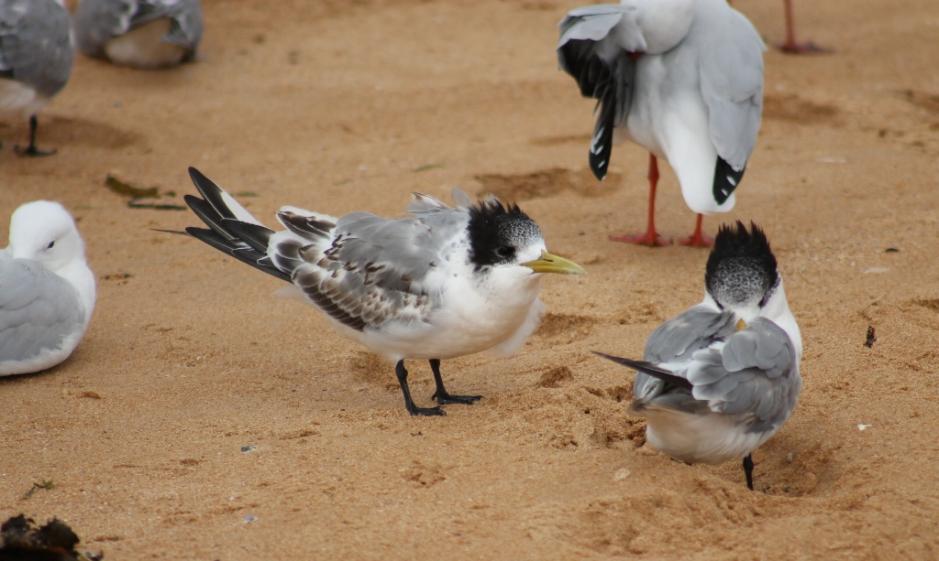
Fledgling Crested Tern at south Mona Vale Beach, picture: A J Guesdon, 2014
A Crested Tern reported to authorities by a Warriewood resident on August 28 has become Pittwater’s first H5 Bird Flu fatality. The NSW Government officially announced the death on Thursday September 3, stating two other cases, another Crested Tern at Port Kembla, and a Hutton’s shearwater at Corindi in Coffs Harbour, were confirmed cases.
This is the first confirmed detection in a shearwater bird in NSW.
As of 3 September 2026, there are 20 H5 bird events in NSW and 468 across Australia.
There are no signs of any mass mortality in the area or anywhere else in NSW and surveillance is continuing so authorities can detect any further cases early.
Given the spread of bird flu across Australia, NSW now reports detections under the nationally consistent event system, where a single investigation may involve one or more birds and considers factors such as location, timing, species and other findings.
A national surveillance plan is in operation to monitor for any further detections and facilitate rapid, coordinated response.
The NSW Government states Bird flu has not been detected in commercial poultry flocks, captive birds or any other birds native to NSW and the risk to human health remains low.
The Government is continuing to receive many calls to the Emergency Animal Disease hotline and key stakeholders are being briefed regularly on the current situation.
The NSW Government has commenced a rollout of targeted vaccinations for vulnerable species of birds to help protect them against H5 avian influenza.
See report last week: Manly’s Little Penguins to be vaccinated Against H5 Bird Flu + Lion Island Little Penguins Update
A combination of insurance populations in captivity, and wild populations of birds, are in the process of being vaccinated. This includes the Little Penguins in Manly and Barunguba Montague Island.
Avian influenza, commonly called bird flu, is a viral disease that primarily affects birds. Some strains cause mild disease, while others, including the H5N1 now impacting Australian wildlife, can cause severe illness and death in birds.
”The virus can spread through droppings, feathers, saliva, and other body fluids, and can be carried by wild birds, including migratory birds and seabirds. In the right conditions, the virus can survive in the environment for months and can spread through contaminated clothing and shoes, contact with infected birds or other infected animals, or contaminated environments or surfaces.
Despite the name, bird flu doesn’t only affect birds. This strain has been detected overseas in mammals, including seals, foxes, cats and dogs. As of August 2026 H5N1 has killed various bird species, long-nosed fur seals, and a dolphin [in Australia]. ”
Several organisations and academics state residents should avoid feeding wild birds if they do at present as these could spread the disease further – see article below.
The NSW Government states it continues to work closely with Australian and State and Territory governments to roll out the plans developed with industry, agriculture and wildlife organisations.
The Chief Veterinary Officer has advised the poultry industry that there is at this stage only a voluntary housing recommendation for poultry birds.
Minister for the Environment Penny Sharpe said:
“We are deeply concerned about the impact that H5 bird flu could have on our native wildlife.
“No government policy can stop this virus from spreading through our wild bird populations. What we can do to support our wildlife is vaccinate insurance populations, protect their habitat and eliminate invasive species.
“The public also has an important role to play by avoiding contact with sick or dead birds and reporting them to the Emergency Animal Disease Hotline, helping us detect new cases and target our surveillance efforts.”
If you see sick or dead wild birds, domestic birds, marine mammals or other wildlife showing signs of H5 bird flu:
- Avoid contact
- Record what you see
- Report it via the online reporting form or Emergency Animal Disease Hotline -1800 675 888.
Dogs Chasing Wild Birds on Beaches – Wildlife in Bush Reserves
Although dogs are not allowed, under NSW Law, to rush at, chase, or harass native wildlife or other animals, the NSW Minister for Agriculture Tara Moriarty said on Thursday:
“NSW so far has 20 H5 bird events, while the rest of Australia has more than 460, and there have been no mass mortality or poultry bird events.
“Our focus is on preparedness, surveillance and responding to events quickly.
“Now is the time for everyone who has backyard chickens or pet birds in aviaries to take precautionary steps to ensure there are no interactions between their chooks and pets with wild birds.
“The Government also recommends people be careful with their dogs if walking on beaches or parks and ensure they don’t eat carcasses or chase wild birds. There is low risk of exposure but it’s important to minimise any risk for your pets”.
Studies undertaken overseas, in China in 2010 – where dogs were deliberately infected [1.], and in the U.K. – where wild dogs in a zoo fed infected meat [2.], found dogs exposed to the virus will succumb to the disease.
Incidents of H5 bird flu has been infrequent in cats and dogs overseas. When it occurs, there is usually a history of dogs or cats being exposed to sick or dead birds, other animals infected with avian influenza virus, consumption of raw pet food or unpasteurised (raw) milk. Signs may be subtle or mistaken for other illnesses.
Signs can vary between dog and cat breeds and may include:
- fever
- lethargy
- decreased appetite
- reddened or inflamed eyes
- discharge from eyes and nose
- coughing or sneezing
- difficulty breathing
- neurological signs, like tremors, seizures, incoordination, or blindness
- death
Pet birds and poultry – from South Australian Government website:
- Always thoroughly wash your hands with soap before and after handling poultry
- Fence off or put netting over areas of standing water or ponds
- Provide feed and water undercover, so wild birds can’t access it.
- Provide fresh feed and water daily
- Keep feed and water spaces clear of faeces and other organic matter
- Make sure drinking water is treated, especially if it’s straight from a natural water source, such as a river or dam
- Regularly change nesting materials
- Make your premises unattractive to wild birds. Use bird scarers, foils or streamers.
- Where more than one poultry species is usually kept together, separate them from one another – keep chickens, ducks and turkeys separate.
- Limit visitor contact with birds – check if essential visitors have recently been at other premises where poultry are kept
Council Response
The council stated this week it is is working closely with the Department of Primary Industries and Regional Development (DPIRD) who are the lead agency for the bird flu response.
”Our understanding is that DPIRD is triaging reports to the Emergency Animal Disease Hotline and are only collecting birds that meet testing criteria. They have produced a guideline for safe disposal on private property. ” the council said in a statement to the news service
”As Council becomes aware of H5 bird flu cases we increase our monitoring and surveillance of surrounding areas.”
”Council has been preparing for some time for our response on public land including:
- using our Incident Management Team to coordinate response across waste, cleansing, biodiversity, health and safety, environmental health, customer service and other impacted internal teams
- identifying high risk biodiversity areas and identifying any mitigating measures including surveillance
- planning for clean-up and disposal including training staff, stocking PPE, liaising with waste contractors and reviewing disposal procedures
- raising awareness of risks and sharing lead agency communications.”
For more information please visit the NSW Government webpage H5 bird flu in NSW
The Australian Government’s Bird flu (avian influenza) webpage is also loaded with information resources.
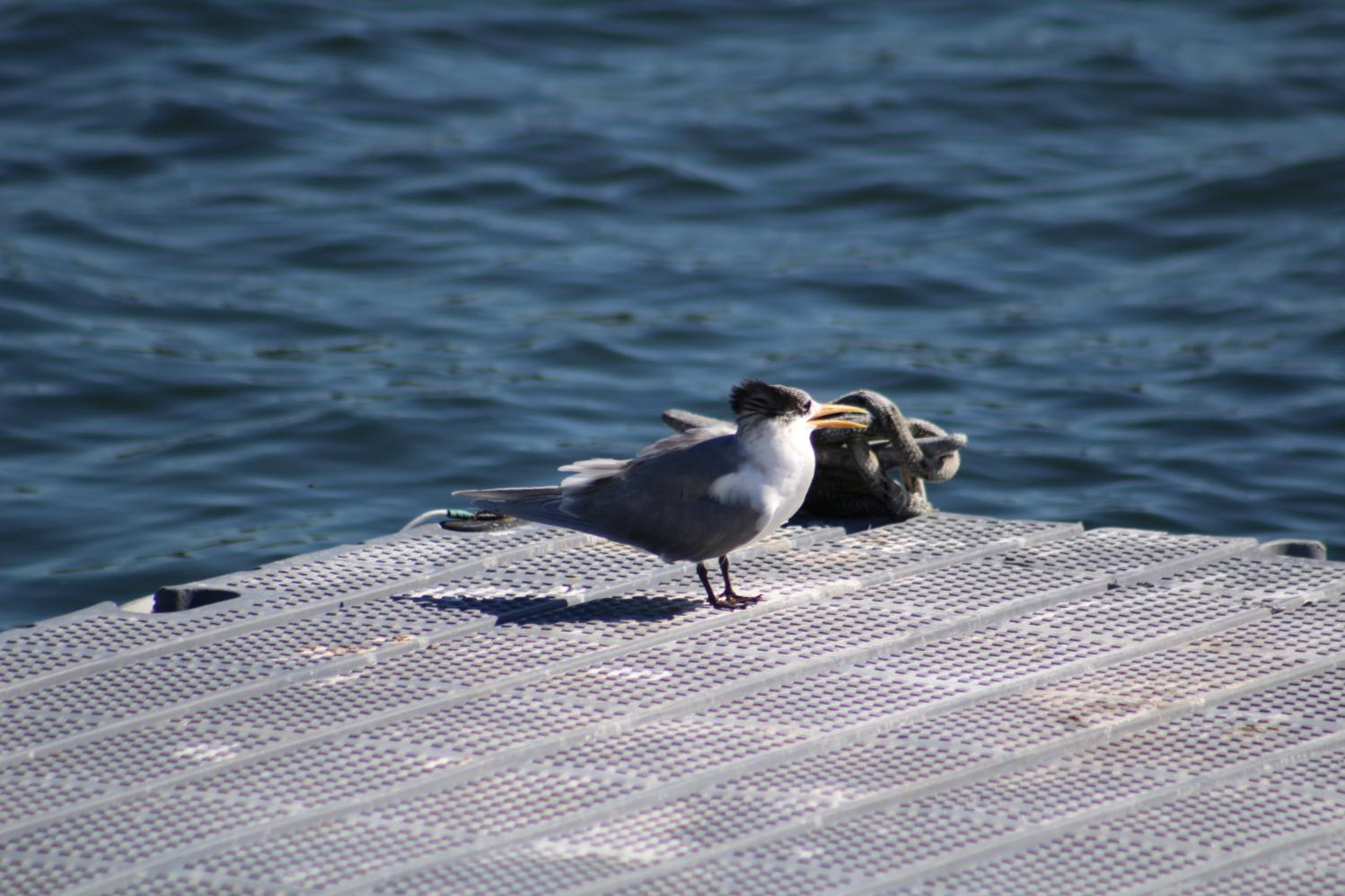
Crested Tern at Palm Beach, one of a pair that live here and nest in North Palm Beach sand dunes.
- Chen Y, Zhong G, Wang G, Deng G, Li Y, Shi J, Zhang Z, Guan Y, Jiang Y, Bu Z, Kawaoka Y, Chen H. Dogs are highly susceptible to H5N1 avian influenza virus. Virology. 2010 Sep 15;405(1):15-9. doi: 10.1016/j.virol.2010.05.024. Epub 2010 Jun 30. PMID: 20580396; PMCID: PMC2914205.
- Marco Falchieri, Scott M. Reid, Akbar Dastderji, Jonathan Cracknell, Caroline J. Warren, Benjamin C. Mollett, Jacob Peers-Dent, Audra-Lynne D Schlachter, Natalie Mcginn, Richard Hepple, Saumya Thomas, Susan Ridout, Jen Quayle, Romain Pizzi, Alejandro Núñez, Alexander M. P. Byrne, Joe James, Ashley C. Banyard. Rapid mortality in captive bush dogs (Speothos venaticus) caused by influenza A of avian origin (H5N1) at a wildlife collection in the United Kingdom. bioRxiv 2024.04.18.590032; doi: https://doi.org/10.1101/2024.04.18.590032